 USCIS.love
What Is a U.S. Talent Visa?
A clear guide to what a U.S. talent visa is, who it is for, and how O-1 differs from EB-1.
Author: Alina Kanametova- updated 8 min read
Full Review with Data
Statistics from 1,242 AAO decisions by field, a comparison of O-1 / EB-1A / EB-2 NIW, templates, and experts are all on the page US Talent Visa: What It Is, Who Qualifies, and How to Apply.
Key answer
The US talent visa is a special type of visa designed for people with extraordinary abilities and achievements in their field, from science and business to arts and sports. Below we explain what the US talent visa is, who it is for, and which categories are included.
What is a talent visa?
A talent visa is not a single visa, but a group of categories that the US sets aside for professionals with proven achievements. The government reviews a person's actual professional level, including awards, publications, industry recognition, and contributions to their field. A diploma or formal education is not the main requirement here.
Separate visa categories for people with extraordinary abilities were established in US law in the 1990s under the Immigration and Nationality Act. Later, countries like Canada, Australia, the UK, and France introduced their own talent programs, but the US structure remains the most well-known.
Key Idea
The US evaluates your achievements, not just your diploma. This means the path is open for specialists from a wide range of fields, not just Nobel laureates or sports stars.
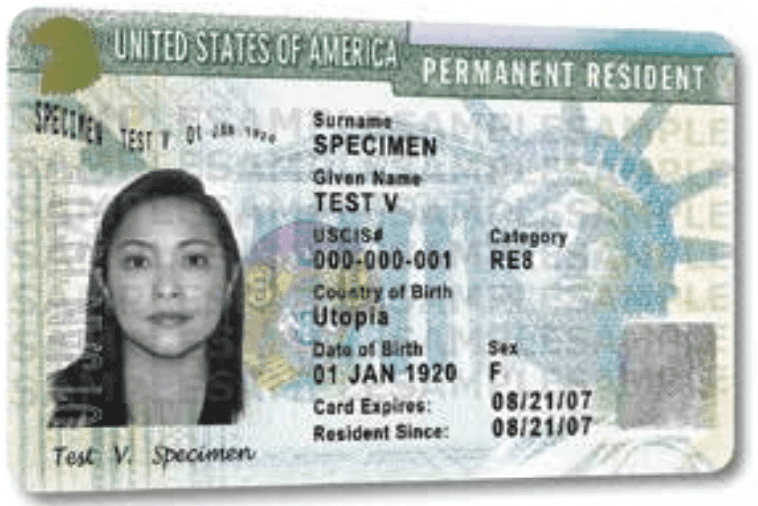
End goal - Green Card (sample Permanent Resident Card)
Who is the talent visa for?
A common misconception is that this visa is only for world-famous individuals. In reality, talent visas are obtained by professionals from very different fields and with varying levels of experience: engineers, scientists, entrepreneurs, marketers, designers, athletes, artists.
The visa is suitable for you if you can document your achievements in your field. This means you have materials showing your level: projects, publications, media mentions, recommendations, participation in significant industry events.
The community often points out that most future applicants start almost from scratch, with experience and determination but without major accolades:
80% of people who apply for O-1, when they first decided to start gathering evidence, also had neither recognition nor scientific publications, almost nothing except desire, education, and impressive experience. Then suddenly everyone is able to find what they need. So the main thing is to have the motivation and drive.
What if your achievements are not strong enough yet?
If your current experience is not enough to apply, it's not a dead end. Often, you can build the necessary profile on purpose: one or two years of focused work on your portfolio, publications, and professional recognition. More on assessing your chances: Self-Assessment.
Experienced community members emphasize that the key is not the diploma itself, but concrete achievements and public recognition, which you can build up:
A diploma is not needed for her, nor for EB1. For O1, though, you need an employer or to open your own company. Experience is good, but what really matters aren't years or confirming experience, but specific achievements (criteria ...) and letters. If you're very non-public, you'll have to work on your public presence: write some articles, try to get PR, participate at conferences, judge hackathons.
Which fields do applicants come from
The idea that talent visas exist only for scientists is not supported by actual case reviews. In the database of 1242 AAO EB-1 appeal decisions collected in this project, the field distribution is as follows:
| Field | Cases in the database |
|---|---|
| Arts and creative professions | 343 |
| Other fields | 219 |
| Science | 155 |
| Business | 143 |
| Sports | 133 |
| Engineering | 94 |
| IT | 69 |
| Marketing | 47 |
| Education | 20 |
| Beauty industry | 19 |
How to interpret these numbers
These are appeals, meaning contested cases: out of 1242 decisions, 991 were denied, 218 were remanded for reconsideration, and 33 were granted. This selection doesn't show approval rates or the actual popularity of categories among all applicants. What it reflects is that people from many different professions, not just academia, reach the talent immigration category. The data can be reproduced using the file lib/data/eb1-cases.json in this project.
Why does the US issue talent visas?
The logic is simple: attract the best specialists in the world. Talented people in business, science, technology, the arts, and sports contribute to the country's economy and innovation. The US addresses its shortage of skilled workers and maintains global competitiveness this way.
For applicants, this means the system is designed in their favor: the government is interested in admitting strong professionals if they can adequately demonstrate their level.
How does O-1 differ from EB-1?
"Talent visa" usually refers to several categories. Most often, this means O-1 and EB-1. Both assess a similar level of achievement but are structured differently.
| O-1 | EB-1 | |
|---|---|---|
| Type | Employment (nonimmigrant, temporary) | Immigrant (green card) |
| Self-sponsorship | US employer or agent required | Possible for EB-1A |
| Term | Up to 3 years, unlimited extensions | Permanent status |
| Annual cap | None | Yes |
O-1: work visa for high-level professionals
O-1 is a nonimmigrant work visa for individuals with extraordinary ability in science, business, education, athletics, or the arts. There is no annual cap or lottery, and the initial duration is up to 3 years, with the possibility of extension. The category is divided into O-1A (science, business, education, athletics) and O-1B (arts, film, television).
Learn more: O-1 Visa Checklist.
EB-1: Green Card for Top Professionals
EB-1 is an immigrant category that leads to a green card and permanent status. The evaluation standard is similar to O-1 ("extraordinary ability"), but the outcome is different: not a temporary work permit, but a path to permanent residence.
Note added 23 September 2026: in practice the two bars have diverged - in Q3 of fiscal year 2025 USCIS approved 66.6% of EB-1A petitions and 54% of EB-2 NIW petitions against a historical 75-80% and 70-75%, while O-1 stayed at 93.8%; see the new evaluation standards.
When choosing between them, community recommendations focus on your goal: if your end goal is a green card, applying for an interim O-1 is not always justified.
depending on your long-term plans, O-1 is non-immigrant and processed faster, EB-1 is immigrant, the process takes longer - but if that's your goal, why go for O-1, it's double the work, money, and time.
How to Choose a Category
O-1 and EB-1 are often considered together: many first work on O-1, then apply for EB-1. Overview of all categories: Visa Types.
How Does the US Talent Visa Differ From the UK One?
If you compare two English-speaking countries, the US has historically been built as a nation of immigrants. It is one of the few countries that hosts green card lotteries, which open the door to citizenship. After living in the US for a certain number of years, a person can naturalize and truly feel at home.
In the UK, the path to becoming a "local" is traditionally more difficult. Detailed comparison: US or UK.
Key Takeaways
- The US talent visa is a set of categories for professionals with proven achievements, not a single visa type.
- The US evaluates actual achievements, not just formal education, so specialists from many different fields may qualify.
- O-1 is a temporary work visa, EB-1 is an immigrant category with a green card; people often apply for them one after the other.
- If you do not have enough achievements yet, you can build your portfolio purposefully within a year or two.
- Compared to the UK, the US has historically offered more opportunities for naturalization.
What changed by September 2026
The core of this article has not changed: the categories are the same, and achievements rather than diplomas are still what gets evaluated. Below are the 2025-2026 developments the article did not cover and that are worth knowing before choosing between O-1 and EB-1, with dates and links to the detailed pages.
- The bar for EB-1A and EB-2 NIW went up; for O-1 it did not. In Q3 of fiscal year 2025 (April-June 2025) the EB-1A approval share was 66.6% against a historical 75-80%, EB-2 NIW 54% against 70-75%, while O-1 stayed at 93.8%. The categories that dropped are the ones with a discretionary second step (final merits); O-1 is closer to a criteria checklist. Community members write that "since last summer" RFEs, NOIDs and denials have become noticeably more frequent. Causes and what to change in a case: new EB-1A and NIW evaluation standards.
- The final merits procedure itself was challenged in court. On 28 January 2026 the District of Nebraska in Mukherji v. Miller held the two-step EB-1A evaluation unlawful; the government appealed to the Eighth Circuit (No. 26-1578), and until that appeal is decided USCIS keeps applying the old procedure. Do not build a case on final merits going away: timeline and positions of the parties.
- Since 10 July 2026 a signature on the form is a ground for denial. Rule 91 FR 25479 wrote into 8 CFR 103.2 the right of USCIS to deny an already accepted I-129 or I-140 because of an invalid signature and keep the fee. A handwritten signature (or its scan, where that filing method is allowed for the form) is valid; a typed name, a pasted image and an electronic signature outside myUSCIS are not. In an EB-1A self-petition the applicant signs; an O-1 petition is signed by the employer or agent, each form separately. Valid/invalid tables: signatures on USCIS forms.
- The consular-stage gap between O-1 and EB-1 became more visible. From 21 January 2026 the State Department suspended immigrant-visa issuance to nationals of 75 countries, including Russia, Belarus and Kazakhstan; nonimmigrant visas, O-1 included, were not covered, and adjustment of status inside the US (I-485) continued as usual. By our data, on 24 August 2026 a court (CLINIC v. Rubio) vacated the suspension, after which the State Department temporarily paused interviews in late August to train officers on the new public-charge rules; the picture changes weekly. Who was affected and what to do: the 75-country visa pause; current status on the administrative processing page.
- The petition is read by more than the officer. Per the DHS AI inventory (January 2026), PDF forms uploaded through myUSCIS are parsed by the Claude 3.7 Sonnet model, and the ELIS classifier tags evidence pages; the decision stays with the officer (what USCIS disclosed about its AI). The practical takeaway for a beginner: consistent spelling of names and organizations across all documents, clean PDFs without hidden layers and a clear exhibit index (the new evaluation standards).
Frequently Asked Questions
Related Materials
This is not legal advice
This material is for general informational purposes and is intended to help you organize your own preparation. This is not legal advice and does not create an attorney-client relationship. US immigration rules change frequently. Refer to the current USCIS requirements and consult a qualified professional before applying.
Related materials - Choose your route
- Types of U.S. Talent Visas: O-1, EB-1, EB-2, and EB-2 NIW
- US talent visa vs the UK Global Talent Visa: how they differ
- O-2 and O-3 Visas: Who Can Accompany Talent to the U.S.
- Roadmap for Getting an O-1/EB-1/EB-2 NIW Talent Visa
- Assess Your Chances for an O-1 or EB-1/EB-2 Talent Visa
- How is visa readiness scored
- O-1 / EB-1 / EB-2 NIW Talent Visa Timelines
- O-1 timeline in 2026: how long after petition approval
- EB-1 and EB-2 NIW timeline 2026: from approval to visa
- Talent Visa Budget: What to Set Aside and Where It Goes
- Glossary of Terms for U.S. Talent Visas O-1, EB-1, EB-2
From community discussions
«Usually this means that formally the criteria are met, but in the officer's opinion they're not enough to establish that the beneficiary is among the small percentage at the very top of the field. There's work at a respected company, but the critical capacity isn't proven, and so on.»
community member · from public community chats
«If it ties in somehow with your contribution to the industry, that your personal methods and developments were used in lectures, etc., then you can add it as one of the pieces of evidence for the contribution-to-industry criterion. Or else only in final merits.»
community member · from public community chats
«And if there are no old articles, how suspicious will it be that I started publishing. Even if I keep a 2-month interval? Can the release of articles be tied to publishing, for example, of a unique method or a "contribution" to the community? For example, I published some unique method and it started getting cited in the media? For an O1 visa is that also critical or does it relate more to EB1?»
community member · from public community chats
Personal opinions of community members from public discussions, not legal advice.
Did this answer help?
Open database - you can improve it
Found something off, or know what to add? Select text and hit "Suggest an edit", or propose an article/topic below.