 USCIS.love
How to track your case after filing an O-1/EB-1 petition
Where to check your USCIS case status after filing a petition, what the main statuses mean, and what to do if there is no response for a long time.
Author: Alina Kanametova- updated 10 min read
Key answer
- Where to check your case status officially?
- Use the USCIS tracker with your receipt number (it starts with three letters and can be found on Form I-797). For the consular stage, check CEAC on the State Department website.
- What does a long delay with no status updates mean?
- By itself, this is not a denial. Many cases show no visible changes until a USCIS officer gets back to them.
After you file a petition for O-1, EB-1, or EB-2, you can track your case yourself using official USCIS and US Department of State services. Below you will find where to check your status, what common status phrases mean, and most importantly, what to do if your status does not change for months: how to know if your case has really gone beyond normal processing times, and in what order requests are made.
How to Track Your Case Status
The status is tied to your case number (receipt number), which starts with three letters and is listed in your Notice of Action (Form I-797, Notice of Action).
- USCIS Case Status Tracker - the main official service: enter your receipt number to see your current status.
- CEAC (Consular Electronic Application Center) - US State Department site to track the status of your visa application at the consular stage.
- Mobile apps for case tracking: Android version and iOS version.
- Checkee.info - third-party site where people worldwide mark status changes on their cases. It can help estimate typical processing times and lets you add your own case.
Create a USCIS Account
An online account on the USCIS website lets you link your case, get notifications about status updates, and store your documents in one place. This is more convenient than checking the status manually every day.
A common expectation that often does not come true is that you will receive your number immediately. According to community reports, sometimes the electronic number shows up the next day after the package is delivered, while the paper receipt arrives in about a week; there can also be delays of three to four weeks, and there have been cases where the notice had to be requested separately.
USCIS Statuses and What They Mean
The wording of statuses in the USCIS tracker changes as your case moves through the process. The most common are:
- Case Was Received - your petition has been accepted and assigned a receipt number. Your case is in the review queue.
- Case Is Being Actively Reviewed - an officer has started reviewing the materials.
- Request for Additional Evidence Was Sent - a Request for Evidence (RFE) was sent. You must prepare and send a response by the specified deadline.
- Response To USCIS Request Received - USCIS has received your response to the request and your case has been placed back in the queue.
- Case Was Approved - your petition was approved. Next come the consular stage or status change within the US.
- Case Was Denied - your petition was denied. The notice will state the reason and possible next steps.
Premium Processing changes timing, not outcome
Paid expedited processing (Premium Processing) shortens the USCIS response time to a fixed number of days, but does not guarantee approval. You may receive a quick RFE or a quick denial.
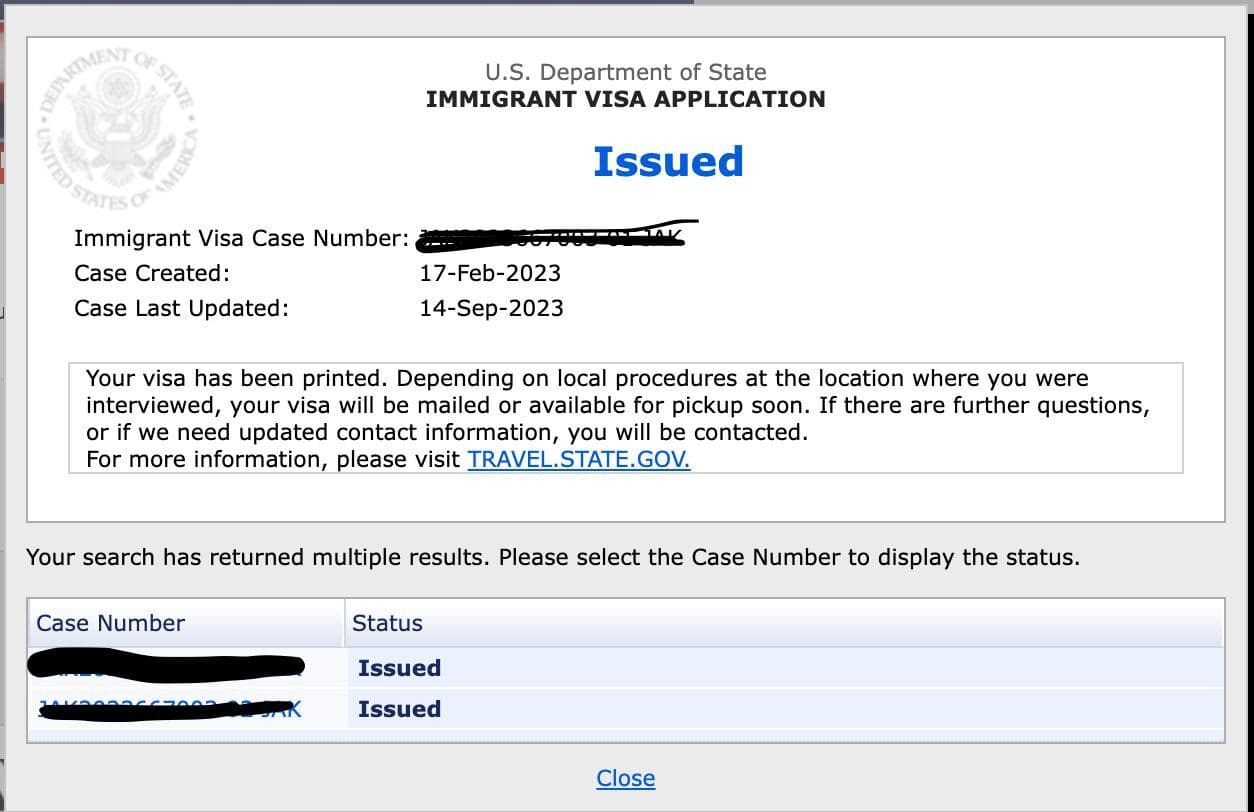
Status in CEAC: Issued - visa printed (case number hidden)
How to know if your case is truly outside normal processing
Before you contact anyone, answer one question: is your case really delayed or are you just anxious? Three clarifications can help.
The published timeframe is not a guarantee. If USCIS says 80 percent of petitions are processed within a certain period, that's just a benchmark for most cases. Some cases are decided faster, some much slower, especially if there's an RFE, office workload, or a change in premium processing availability.
Aggregated I-140 timeframes are poor predictors for your case. They include various categories. For planning, check your specific category, service center, whether premium processing is used, and recent trends.
No updates in the tracker do not mean no movement in your case. Based on community observations, the status may update within a few days after filing, or it may not change for up to 60 days.
For reference, here are observed I-140 timelines from community experience: with premium processing, a decision typically comes within 15 business days, but 45-day waits and longer windows are possible with delays; without premium processing, the typical wait is described as 6-9 months, with some cases around 8 months, and some EB-1A cases stretched 20-23 months. After responding to an RFE, there is no predictable timeline: waiting can take months.
If your case is under review for over a year, it is considered outside of normal processing time, and you can contact your congressperson to intervene.
What to do if there is silence: step-by-step actions
There are only a few tools, and the order matters more than speed. Start with free and reversible steps, then move to costly or irreversible ones.
Compare your timeframe with the official one
Open Check Case Processing Times and find your form, category, and service center. Compare with typical values at Checkee.info. If you are still within the range, no further action is needed for now.
Submit a Case Inquiry via e-Request
If your wait has exceeded the published range, submit a Case Inquiry (outside normal processing time). This same form is also used for missing documents or change of address. It's the first official sign that you tried to resolve the issue.
Contact the Contact Center
USCIS Contact Center provides general support and status inquiries. If your situation is justified, the operator may escalate your request to a higher-level officer.
Congressional inquiry
A free inquiry to the agency from your congressperson's or senator's office. Details below. This is the most underrated step.
CIS Ombudsman
DHS CIS Ombudsman is an alternative channel for USCIS-specific issues. Important: the office will not accept your case if a congressional inquiry was filed within the past 45 days. Choose one tool and wait for the outcome.
Mandamus
A lawsuit in federal court that requires the agency to make a decision, but does not require approval. This is a last resort, not the next step. See the article administrative processing and 221(g) for mechanics, costs, and risks.
It really makes sense to write to every channel: service request, congressman, then a senator a month after the congressman. Then there is also the tier 2 officer and the ombudsman.
A mandamus is a court order that forces a government agency to make a specific decision. It does not have to be in your favor. These are separate procedures.
Congressional inquiry: how it actually works
This is a free service offered by congressional offices, and it is often skipped. The logic is simple: Congress controls agency funding and oversees their work, so an inquiry from a congressman's office is rarely ignored by an agency.
Who to contact. You need a congressman or senator from the state of your employer or intended residence in the US, not the country where you are currently living. You can find your representative at house.gov, senators at senate.gov, or all at once through usa.gov. On the office website, look for sections like Help with a Federal Agency, Constituent Services, or Casework.
What to prepare. A Privacy Release Form is mandatory. Without consent to process your data, the office legally cannot request information about your case. There is also a universal Digital Privacy Release Form. In addition: a copy of your passport photo page, case number or application confirmation, and a brief one-page description of your case. A long emotional letter works against you: the office handles hundreds of inquiries and needs structure and facts.
When to submit. Submitting during the first week of waiting is a common mistake. Offices prioritize cases with long delays.
| Wait time | What makes sense |
|---|---|
| Less than 1 month | Too early |
| 1-2 months | You can, but the answer will be standard |
| 2-3 months | Good time |
| 3-6 months | Worth submitting |
| 6 months or more | Submit if you have not yet done so |
What happens next. The office confirms receipt of your inquiry within one to three days, forwards it to the agency within three to five days, the initial response comes in about five to fourteen days, and the full response within thirty days. The answer is usually one of four types: status confirmation, identification of a problem (additional documents or action needed), moving your case to the next step, or information about a decision already made.
What a congressional inquiry can and cannot do
Can: request your case status, draw attention to it, detect an administrative error or missing documents, request expedited processing if USCIS criteria are met, contact the embassy via the State Department.
Cannot: force an approval or denial, grant automatic priority, schedule an interview if the case is already documentarily complete, overturn a consular officer's decision, or replace legal advice.
The official USCIS internal guide for handling such requests is publicly available: Congressional Inquiries Refresher.
Set realistic expectations. The most common result of an inquiry is a clearer status update rather than faster processing, and the community is upfront about this:
On average, no one in the chat has ever received help from congressional offices. This is generally known. Sometimes there are coincidences. But since this is a black box, no one can say for sure.
There are also opposite observations, noting that an inquiry from an organization has more weight than one from the applicant alone:
Do it. But in my opinion, it's better if the employer submits it, because you yourself mean nothing to the congressperson.
Common mistakes, briefly: submitting before one month has passed, picking a congressperson from the wrong state, sending a long emotional letter instead of a one-page summary, contacting multiple offices at once, expecting immediate acceleration, and sending a request without a Privacy Release Form.
Timelines and What to Do If There's No Update at the Consular Stage
Processing times depend on petition type, service center, and whether you requested premium processing. At the consular stage, there may also be administrative processing, which can be especially lengthy for technical fields:
Currently, the review takes about 1.5 years on average.
- Refer to the current processing times on the Check Case Processing Times page on the USCIS website. These are estimated ranges by form and center.
- Compare your timeline with typical values on Checkee.info to see if your case falls outside the norm.
- If your case is outside the published timeframe, you can submit a Case Inquiry (outside normal processing time) on the USCIS website.
- Prolonged inactivity by itself is not a denial. Many cases show no visible status changes until an officer returns to them.
Keep in mind that status in CEAC is tracked differently from the USCIS tracker. "Administrative processing" does not mean the case is nearly approved, and "Refused" under 221(g) is usually not a final denial. Both are technical notations while processing continues. The mechanism and possible outcomes are explained in administrative processing and 221(g).
Those who have gone through long waits advise against checking your status every day. Frequent checks only make you more anxious:
So there's really no point in sitting on CEAC and constantly monitoring the status updates. Maybe check once a week, just in case.
At the consular stage, it helps to occasionally and calmly follow up by email through official channels instead of panicking over an unchanged status:
We emailed the embassy every month, always got a standard reply, and the date only updated once at the beginning.
Where to Write
If your status hasn't changed for a long time or you received a request, contact the official channels.
- USCIS Contact Center - general support and status inquiries.
- e-Request - online requests: cases outside normal processing time, undelivered documents, change of address.
- DHS CIS Ombudsman - help with USCIS problems (but not at the same time as a congressional inquiry).
- For the consular stage: use the website and contacts of the specific U.S. embassy or consulate handling your case.
Keep Your Information Handy
For any inquiry, you'll need your receipt number, petition type, and the dates of key notifications. Save all letters from USCIS since they include deadlines and instructions.
Conclusions
- The main tool is the official USCIS case tracker by receipt number. For the consular stage, check CEAC.
- Set up a USCIS online account to receive status change notifications.
- Learn the main statuses: from Case Was Received to Approved or Denied, and separately about RFEs.
- Compare your timeline with official processing times and community reports before worrying about delays. The "80 percent of cases" figure is a benchmark, not a guarantee.
- If your case goes beyond normal processing time, submit a Case Inquiry through e-Request instead of waiting indefinitely.
- Escalation process: check times, e-Request, Contact Center, congressional inquiry, Ombudsman, and only then mandamus.
- Congressional inquiry is free and usually provides clarity, not speed. Don't combine it with the Ombudsman-follow the 45-day rule.
0 of 7 checked- saved in this browser only
Frequently Asked Questions
Related Materials
What is an RFE and How to Respond
Visa Bulletin and Priority Dates
Scheduling an Interview
NVC Checklist for EB-1
Administrative Processing and 221(g)
What Happens After EB-1 / EB-2 Petition Approval
Actual Timelines by Stage
Why RFEs Are Issued: Reasons and Statistics
This is not legal advice
This material is for general informational purposes and helps you organize your own preparation. It is not legal advice and does not create an attorney-client relationship. U.S. immigration rules change so check current USCIS requirements and consult a qualified professional before applying.
Related materials - Wait for the decision
- RFE: What Is a Request for Evidence
- Why an RFE Comes: Causes and Statistics
- RFE response: how to answer USCIS step by step
- How to format evidence so USCIS counts it: real RFEs
- NOID: how to respond to a Notice of Intent to Deny
- What Happens After EB-1 / EB-2 Petition Approval
- How to Read the Visa Bulletin for EB-1 and EB-2
- Priority Date: How to Find It and What It Means
- Final Action Dates and Dates for Filing
- The standards that trigger an RFE
- How the evidence was gathered
- Mandamus and Congress: what really works in case of delay
- USCIS uses AI: Claude, ELIS, ATLAS, and FOIA requests
From community discussions
«Many people get approved without this criterion at all, or with four publications over four months. Don't worry: if you're not a Nobel laureate, everyone's chances are roughly the same. Any case can be shot down at the Final Merits stage - that's a subjective assessment at the second stage. It's curable by refiling. If you don't give up the fight, you'll make it to the States.»
Egor · from public community chats
«The O-1 is not an immigrant visa. Its criteria are easier than for EB-1A, and you can pick the embassy and interview date yourself, the AP risk is lower. For EB-1A the criteria require stronger arguments. That's why many people first do the O-1, enter the US, and once the EB-1A is approved they get the green card without trouble with the consulate. By the way, an EB-1A approval at USCIS isn't a 100% approval yet - the consul can send the case back to USCIS for review.»
Ol · from public community chats
«EB-1A has more criteria and they're stricter, but on the other hand they're described in detail and the officer's actions are more limited and formalized. While EB-2 NIW is one big flight of fancy. Even in the USCIS officer's manual for this visa there are no clear instructions. If he wants, he approves it, if he doesn't want to, he kills it.»
Ol · from public community chats
Personal opinions of community members from public discussions, not legal advice.
Did this answer help?
Open database - you can improve it
Found something off, or know what to add? Select text and hit "Suggest an edit", or propose an article/topic below.